
Preloader Close
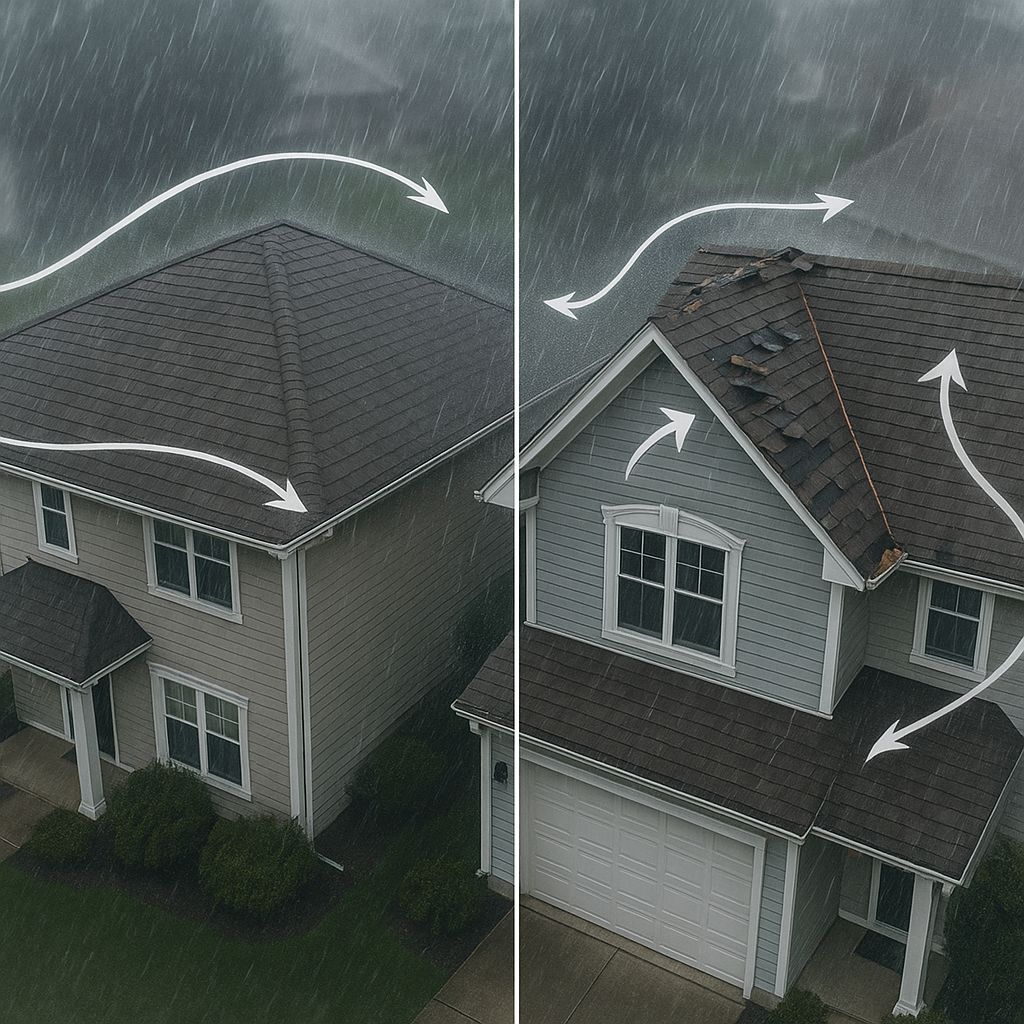
How Hip Roofs Perform Better in Florida Hurricane Winds
Key Takeaways: Hip Roof Hurricane Protection
- Hip roofs offer up to 40% better wind resistance than gable roofs during Florida hurricanes due to their aerodynamic four-sided design
- Homeowners with hip roofs can save up to 32% on insurance premiums in Florida’s hurricane-prone regions
- Hip roofs distribute wind pressure more evenly, significantly reducing the risk of catastrophic roof failure during storms
- Florida building codes now recognize hip roofs as preferred structures in high-velocity hurricane zones (HVHZ)
- While initially more expensive, hip roofs provide substantial long-term protection and financial benefits for Florida homeowners
When hurricane-force winds bear down on Florida homes, your roof design can mean the difference between minor repairs and catastrophic damage. As a Florida homeowner, understanding this critical distinction could save you thousands in repair costs and countless headaches during storm season.
Florida’s Hurricane Challenge: Why Your Roof Design Matters
Florida’s relationship with hurricanes is long and tumultuous. With over 1,350 miles of coastline exposed to the Atlantic Ocean and Gulf of Mexico, the Sunshine State faces more hurricane threats than any other U.S. state. The devastating impacts of hurricanes like Andrew (1992), Irma (2017), and Michael (2018) have reshaped not only landscapes but also how we approach residential construction.
When hurricane-force winds—sometimes exceeding 150 mph—collide with your home, the roof typically experiences the most significant stress. It’s not just about withstanding direct wind force; it’s about managing the complex pressure systems that develop around your home during a storm. Schneider Insurance data shows that roof damage accounts for approximately 70-90% of insured residential hurricane losses, making your roof’s design perhaps the most crucial element in your home’s hurricane defense system.
Modern building science has revealed that not all roof designs perform equally when facing these brutal forces. The shape, pitch, and construction method of your roof dramatically influence how it handles hurricane-strength winds. Among the various roof designs, hip roofs have consistently demonstrated superior performance—and understanding why could be vital to protecting your Florida home.
Hip Roofs vs. Gable Roofs: The Critical Structural Differences
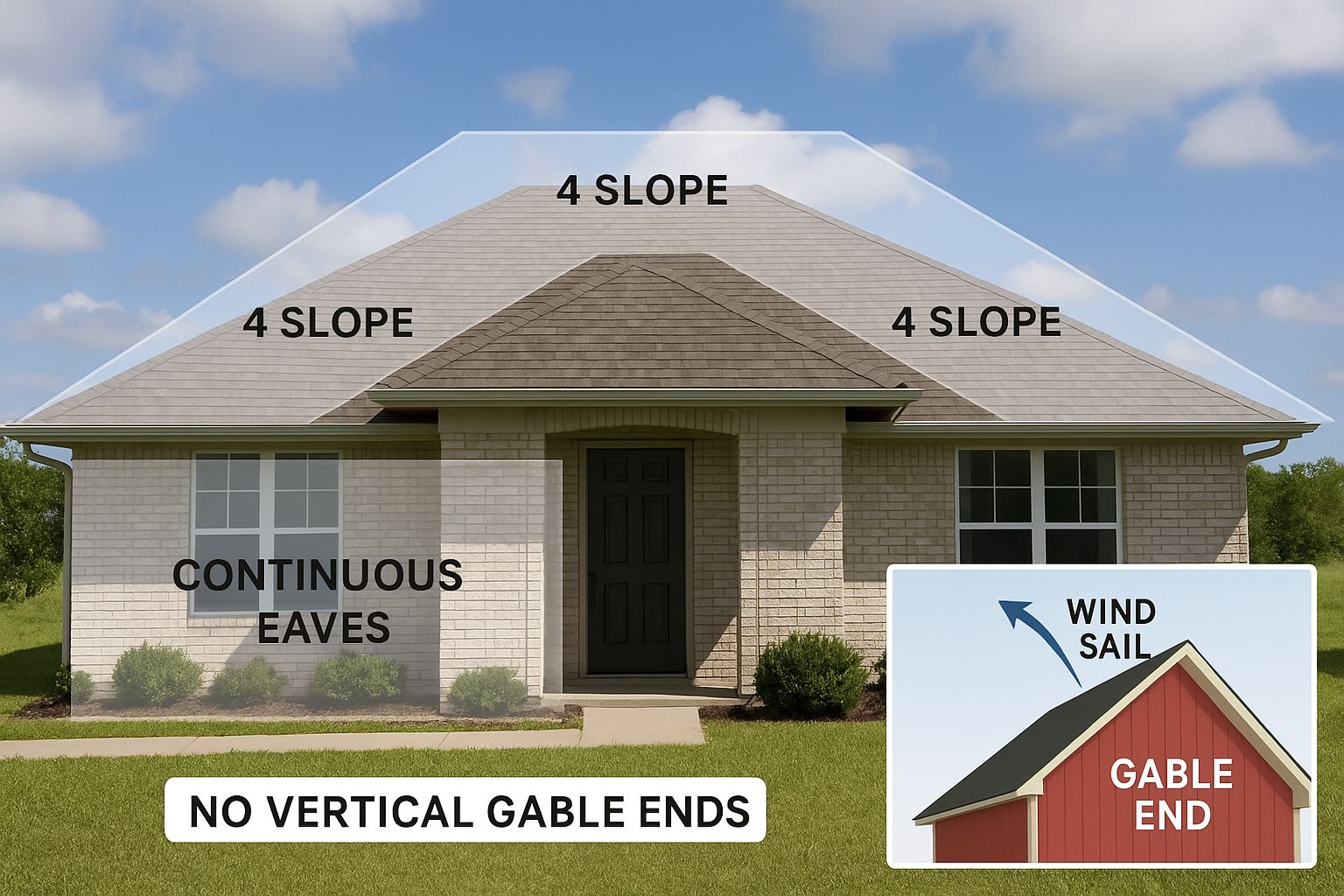
To understand why hip roofs excel in hurricane conditions, we must first identify what makes them structurally different from their more common counterpart, the gable roof. These differences aren’t just aesthetic—they fundamentally change how your home responds to extreme weather events.
What Makes a Hip Roof Different
A hip roof features slopes on all four sides that come together at the top to form a ridge (sometimes just a point on smaller structures). This creates a self-bracing, structurally sound design with no vertical ends. The four-sided approach means that no matter which direction hurricane winds blow from, they encounter a sloped surface that can help deflect and channel wind forces more effectively than flat surfaces. The inward slopes on all sides also create a naturally more rigid and stable structure, with walls that receive equal support from the roof structure above.
Why Gable Roofs Are More Vulnerable in Hurricanes
Gable roofs, with their familiar triangular ends, have two sloped sides that meet at a central ridge with vertical gable ends on two sides. These vertical gable ends become particularly problematic during hurricanes. When hurricane winds hit these flat, vertical surfaces, they create immense pressure that can cause the gable end to collapse inward or outward. Furthermore, the vertical ends offer less structural stability to the overall roof system, making gable roofs more susceptible to uplift forces that can literally tear a roof from its supports.
Post-hurricane assessments consistently show that gable roofs suffer significantly more damage than hip roofs in the same neighborhoods experiencing identical wind conditions. The vertical ends not only catch wind like a sail but can also create dangerous pressure differentials that stress the entire roof structure beyond its breaking point.
The Four-Sided Advantage During High Winds
The four sloping sides of a hip roof create an inherent structural advantage that becomes crucial during hurricane conditions. This design distributes wind pressure more evenly across the entire structure rather than concentrating force on vulnerable areas. When hurricane winds strike a hip roof from any direction, they encounter a similar aerodynamic profile, which helps minimize pressure differences that could lead to structural failure.
Additionally, the four-sided design creates multiple triangular planes that naturally reinforce each other, forming an inherently rigid structure. This rigidity helps prevent the progressive failure that often occurs with gable roofs, where damage to one section quickly cascades throughout the entire roof system. Engineers have found that this four-sided approach can reduce peak wind pressures by 20-40% compared to gable designs, which can make the critical difference between a roof that survives and one that fails catastrophically during a hurricane.
The Science of Wind Resistance in Hip Roof Designs
Understanding the physics behind hurricane wind interactions with different roof structures reveals why hip roofs consistently outperform other designs. When hurricane-force winds—which can exceed 150 mph in Category 5 storms—make contact with a building, complex aerodynamic forces come into play that can spell disaster for poorly designed structures.
These forces don’t just push against your home; they create pressure differentials that can literally pull a roof apart. The science behind wind resistance isn’t just theoretical—it’s backed by decades of wind tunnel testing and real-world post-storm assessments.
How Hurricane Winds Interact With Different Roof Shapes
When hurricane winds strike a home, they don’t simply push against it in a straight line. Instead, they create complex airflow patterns that generate both positive pressure (pushing) on windward surfaces and negative pressure (pulling) on leeward surfaces and the roof itself. This negative pressure, or suction effect, is often what causes catastrophic roof failures, as it can lift roofing materials and even entire roof structures away from the building.
Hip roofs handle these complex wind patterns far better than gable roofs because they present sloped surfaces to the wind regardless of direction. Wind flowing over a hip roof creates more consistent pressure distributions without the dramatic pressure differentials that occur at the corners and edges of gable roofs. This reduces the likelihood of localized failures that can quickly cascade into complete roof system collapse.
Pressure Distribution and Uplift Forces
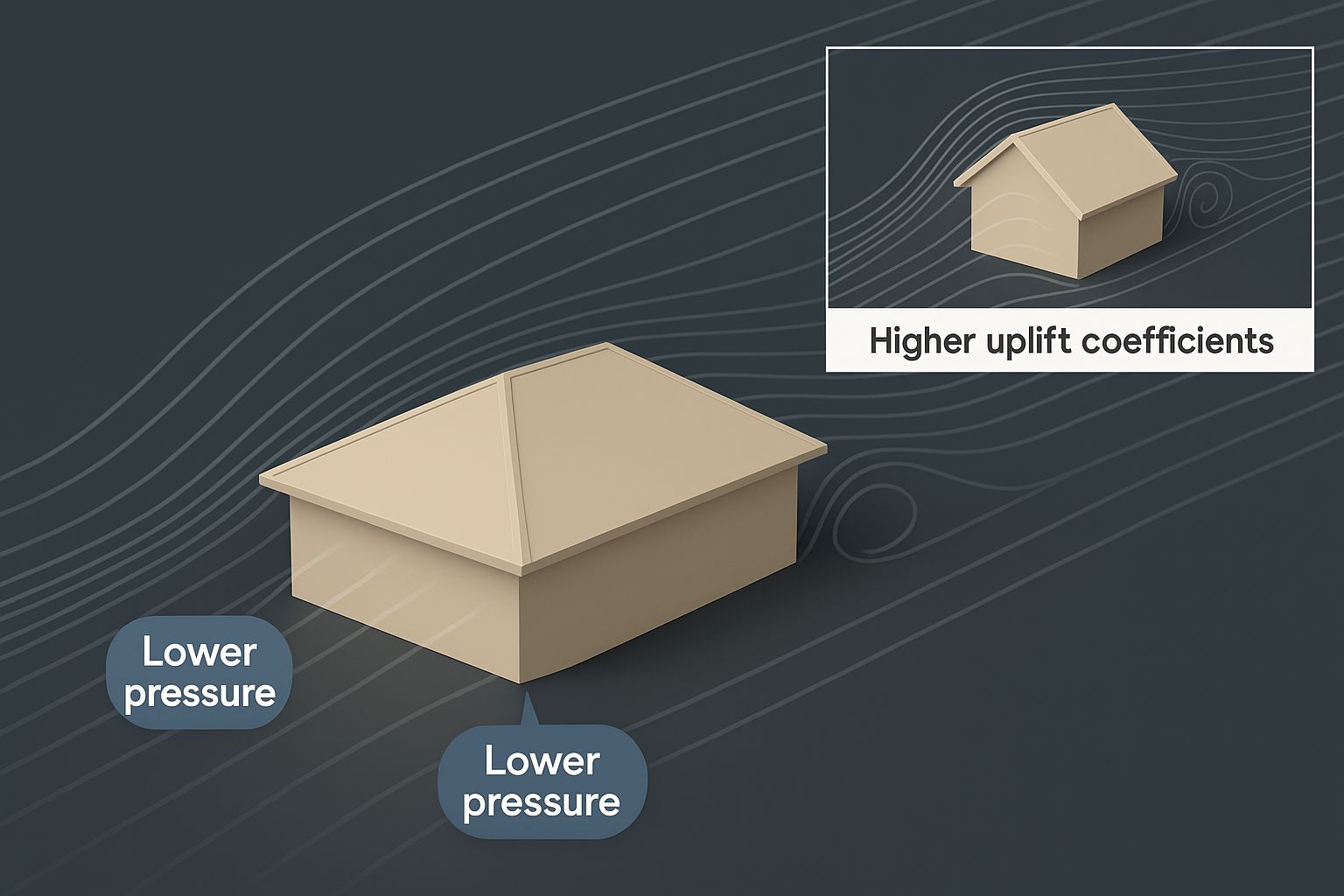
One of the most dangerous effects during a hurricane is uplift—the suction force that tries to lift your roof off your home. Wind tunnel studies show that hip roofs experience approximately 40% less uplift force than comparable gable roofs in the same wind conditions. This significant reduction occurs because the wind flows more smoothly over the hip roof’s sloped surfaces without creating the strong vortices (swirling air currents) that form along the edges and corners of gable roofs.
The reduced uplift is particularly important at the corners and edges of the roof, where damage typically begins. Hip roofs distribute these forces more evenly across the entire structure, preventing the concentration of stress that can tear roofing materials away and compromise structural integrity.
The Aerodynamic Edge: Wind Flow Over Hip Roofs
Hip roofs possess an inherent aerodynamic advantage that becomes crucial during hurricane conditions. Their shape allows wind to flow more smoothly over all surfaces, similar to how an airplane wing is designed to minimize turbulence. When hurricane winds encounter a hip roof, they’re guided up and over without creating the turbulent air pockets that can pry at roofing materials and connections.
This aerodynamic efficiency means less wind energy is transferred to the structure itself. Wind tunnel testing at Florida International University’s Wall of Wind facility has confirmed that hip roofs experience significantly reduced pressure coefficients (measurements of wind force) compared to gable designs, particularly in the critical areas where roof sections meet walls.
Optimal Pitch Angles for Maximum Wind Resistance
The angle of a hip roof’s slope (pitch) plays a crucial role in its hurricane performance. Research indicates that moderately pitched hip roofs—between 4:12 and 6:12 (18.4° to 26.6°)—offer the optimal balance of wind resistance and practical construction considerations. This moderate pitch provides sufficient slope for wind deflection without creating excessive height that would increase wind loads on the structure.
Very low-pitched hip roofs (below 3:12) sacrifice some aerodynamic benefits and may experience higher uplift forces, while extremely steep pitches can increase the surface area exposed to wind forces. Florida building codes now recognize this science by offering greater design pressure reductions for hip roofs within this optimal pitch range.
Real-World Performance: Hip Roofs in Past Florida Hurricanes
Theory and laboratory testing provide valuable insights, but the real proof of hip roof superiority comes from examining actual hurricane aftermath. Post-storm damage assessments consistently reveal striking patterns that validate the scientific predictions about roof performance.
Case Study: Hurricane Irma Roof Performance
When Hurricane Irma swept across Florida in 2017, it created a real-world laboratory for assessing roof performance. In neighborhoods throughout Southwest Florida where winds reached 130+ mph, damage patterns were remarkably consistent. Homes with hip roofs experienced approximately 70-80% less catastrophic roof failures than neighboring properties with gable roofs constructed during the same period.
One particularly revealing study in Cape Coral found that among 800 homes surveyed in a subdivision hit by Irma’s eyewall, only 3% of homes with hip roofs suffered major structural roof damage, compared to 19% of homes with gable roofs. These weren’t just minor differences—they represented the dividing line between homes that remained habitable and those that required complete rebuilding.
What Building Inspectors Found After Major Storms
Professional assessments by building inspectors following hurricanes Michael, Irma, and earlier storms have consistently documented specific failure patterns in gable roofs that rarely occur in hip roof structures. The most common failure points include gable end collapses, roof sheathing loss starting at corners and edges, and progressive failures where initial damage quickly spreads across the entire roof system. These patterns appeared so consistently that they’ve directly informed building code revisions and insurance underwriting standards throughout Florida.
Florida Building Codes and Insurance Benefits
Florida’s painful hurricane history has led to some of the nation’s most stringent building codes, particularly regarding roof construction. These codes recognize the superior performance of hip roofs and create tangible incentives for homeowners who choose this design.
The evolution of these regulations directly reflects the lessons learned from each major hurricane. After Hurricane Andrew devastated South Florida in 1992, revealing catastrophic weaknesses in building practices, Florida completely overhauled its building codes. These reforms have continued to evolve with each subsequent major storm, increasingly favoring hip roof designs.
Current Code Requirements for Hurricane Zones
Florida’s building code now categorizes certain coastal areas as High-Velocity Hurricane Zones (HVHZ), with specific provisions that favor hip roof construction. In these zones, gable roof designs face more stringent requirements, including specialized bracing and reinforcement that can significantly increase construction costs. Hip roofs, by contrast, inherently meet many of these requirements through their design, making them increasingly the default choice for new construction in hurricane-prone regions.
The Florida Building Code now recognizes the superior performance of hip roofs by allowing reduced design pressures for hip roofs compared to gable designs. This translates to potentially lower construction costs for roof connections and components while still meeting or exceeding safety standards. The code specifically grants a 10% reduction in roof design pressure for hip roofs with slopes between 4:12 and 6:12 – a significant advantage that reflects their real-world performance advantages.
Insurance Discounts for Hip Roof Homes
Florida’s insurance companies have taken notice of the dramatic performance differences between roof designs during hurricanes. Most major insurers now offer substantial premium discounts for homes with hip roofs, recognizing that these structures are far less likely to result in catastrophic claims. These discounts aren’t trivial – they can significantly impact your long-term homeownership costs in Florida’s increasingly expensive insurance market.
The specific discount percentages vary by insurance provider, location, and other factors, but hip roof discounts typically range from 15% to 32% off the windstorm portion of homeowners insurance premiums. For a typical Florida home, this can translate to annual savings of $400-$1,200. When compounded over the lifetime of homeownership, these savings can offset or even exceed the additional construction costs associated with hip roofs.
Potential Savings on Premiums (Up to 32%)
The financial benefits of hip roofs extend well beyond direct damage prevention. With Florida’s property insurance rates among the highest in the nation – and still climbing – the premium reductions available for hip roof homes can represent one of the few reliable ways to control these escalating costs. The premium savings are particularly significant in coastal and near-coastal areas where windstorm coverage represents a larger portion of the total insurance premium.
For example, a 2,200-square-foot home in Naples might save approximately $900 annually with a hip roof discount. Over a 15-year period, those savings would total $13,500 – often exceeding the additional upfront construction cost of choosing a hip roof design. This financial advantage becomes even more pronounced when factoring in the reduced likelihood of paying out-of-pocket deductibles after storms and the avoided costs of temporary housing during extended repairs.
Strengthening Your Existing Roof Against Hurricanes
While new construction offers the clearest path to implementing hip roof designs, many Florida homeowners face the reality of protecting existing homes with gable roofs. Fortunately, several retrofit options can significantly improve hurricane resistance without complete roof replacement – though none quite match the performance of a properly designed hip roof.
Retrofit Options for Gable Roofs
If your home has a gable roof, several targeted reinforcement strategies can improve its hurricane resistance. Gable end bracing is one of the most cost-effective approaches, involving the installation of diagonal braces connecting the gable end wall to the roof structure and ceiling joists. This reinforcement helps prevent the gable end from collapsing inward or outward during high winds – a common failure point during hurricanes.
Another effective retrofit involves the installation of gable end brackets that connect the roof framing directly to wall structures, providing additional support against uplift and lateral forces. For homes with gable overhangs, securing these vulnerable areas with additional fasteners and hurricane clips can prevent the progressive failure that often begins at these exposed edges.
Hurricane Straps and Structural Reinforcements
Regardless of your roof design, hurricane straps (also called hurricane clips) represent one of the most important reinforcements for Florida homes. These galvanized metal connectors create stronger connections between roof trusses or rafters and the supporting walls, dramatically increasing resistance to uplift forces. Modern building codes require these connections in new construction, but older homes often lack this crucial protection.
Beyond the basic hurricane straps, more comprehensive structural reinforcements can include enhanced sheathing attachment (using ring-shank nails at closer intervals), secondary water barriers beneath roofing materials, and reinforced soffit installations to prevent wind entry into attic spaces. While these improvements don’t transform a gable roof into a hip roof, they can significantly narrow the performance gap during moderate hurricanes.
When to Consider a Full Roof Replacement
For homeowners with older gable roofs, particularly those approaching the end of their service life, converting to a hip roof design may be worth considering. The ideal time for such a conversion is when the roof already requires replacement due to age or damage. Though converting from gable to hip involves significant structural changes and costs considerably more than a simple re-roofing, it provides the opportunity to incorporate state-of-the-art hurricane resistant features while gaining the inherent structural advantages of hip roof design.
This conversion becomes particularly attractive when factoring in the potential insurance savings, increased home value, and peace of mind during future storms. For homes in highly vulnerable coastal locations or for homeowners planning to remain in their homes long-term, the conversion investment often makes financial sense when analyzed over a 10-15 year timeframe.
Cost Considerations: Are Hip Roofs Worth the Investment?
The superior hurricane performance of hip roofs comes with higher initial construction costs – a reality that prompts many homeowners to question whether the investment is worthwhile. Understanding both short-term costs and long-term benefits is essential for making an informed decision.
Initial Construction Cost Comparison
Hip roofs typically cost 15-20% more than comparable gable roofs for new construction. This cost differential stems from several factors: greater complexity in framing, more materials required for the additional slopes, more complicated intersection details, and increased labor for the more intricate construction. For a typical 2,000-square-foot Florida home, this might represent an additional construction cost of $4,000-$8,000 compared to a basic gable design.
However, this straightforward comparison doesn’t tell the complete story. When building in Florida’s High-Velocity Hurricane Zones, the additional bracing and reinforcement required for gable roofs to meet code requirements can significantly narrow this cost gap. In some cases, properly reinforced gable designs may cost nearly as much as hip roofs while still not matching their inherent structural advantages.
Long-Term Savings on Repairs and Insurance
The true financial calculation must consider long-term factors beyond initial construction. Hip roofs typically require fewer repairs over their lifespan, particularly after severe weather events. Even during hurricanes that don’t cause catastrophic failures, gable roofs often suffer localized damage requiring expensive repairs and potentially leading to water intrusion issues. These repeated smaller repair costs can accumulate significantly over time.
The insurance premium differentials mentioned earlier represent perhaps the most predictable financial advantage. Annual savings of $400-$1,200 on insurance premiums add up quickly, often reaching or exceeding the initial cost differential within 5-10 years. Additionally, homes with hip roofs typically maintain higher resale values, particularly in coastal areas where hurricane resistance is a primary concern for buyers.
Return on Investment Timeline
For most Florida homeowners, the break-even point for the additional cost of a hip roof occurs between years 5-8 of ownership, assuming typical insurance savings, reduced maintenance costs, and average storm frequency. This return-on-investment calculation becomes even more favorable in highly hurricane-prone coastal areas or for homeowners planning long-term residency. When factoring in the potential avoided deductibles after major storms (which can range from $2,500 to over $10,000), the financial case becomes even stronger.
Beyond Hurricane Protection: Additional Benefits of Hip Roofs
While hurricane resistance represents the primary advantage of hip roofs in Florida, these designs offer several additional benefits that enhance their overall value. These secondary advantages contribute to both the practical functionality and aesthetic appeal of your home.
The comprehensive benefits of hip roofs extend far beyond storm protection, creating year-round advantages for Florida homeowners. Their balanced appearance and classic profile work well with various architectural styles, from Mediterranean to modern designs, making them a versatile choice for new construction.
The structural characteristics that make hip roofs hurricane-resistant also contribute to their durability in everyday conditions. The inherent stability means less stress on roofing materials, potentially extending their lifespan compared to the same materials installed on gable roofs. This translates to fewer maintenance issues and repairs over the roof’s lifetime.
Many Florida homeowners report that hip roofs provide greater peace of mind during hurricane season. Knowing your home has superior protection against one of Florida’s most persistent threats creates significant psychological benefits that, while difficult to quantify financially, represent real value for residents of storm-prone regions.
- Superior wind resistance through aerodynamic four-sided design
- Insurance premium discounts up to 32% on windstorm coverage
- Enhanced structural stability in all weather conditions
- Better drainage capabilities during heavy Florida downpours
- Increased energy efficiency through more consistent attic temperatures
- Higher resale value and improved curb appeal
Enhanced Drainage During Heavy Florida Rains
Florida’s climate brings not only hurricane winds but also torrential rainfall that can challenge roofing systems. Hip roofs excel in water management because they typically feature eaves on all sides, creating a continuous drainage path that directs water away from the foundation and walls. This consistent drainage pattern prevents the concentrated water flow that often occurs with gable designs, reducing the risk of soil erosion around foundations and water intrusion at wall connections.
Energy Efficiency Advantages
Hip roofs can contribute to better energy efficiency in Florida’s hot climate. The design typically creates more consistent attic spaces with improved ventilation possibilities and fewer extreme hot spots. When combined with proper insulation and ventilation systems, hip roofs help maintain more moderate attic temperatures, reducing the cooling load on your home’s air conditioning system during Florida’s long, hot summers. Some homeowners report cooling cost reductions of 7-11% after converting from poorly ventilated gable designs to properly constructed hip roofs with enhanced ventilation.
Architectural Appeal and Home Value
Beyond their practical advantages, hip roofs offer aesthetic benefits that can enhance your home’s curb appeal and market value. Their balanced, symmetrical appearance creates a solid, substantial profile that many homebuyers find attractive. Real estate professionals in Florida’s coastal communities report that homes with hip roofs often sell more quickly and at premium prices compared to similar properties with gable roofs, particularly in areas with recent hurricane history or in neighborhoods where insurability is a significant concern.
Make the Right Roof Choice for Hurricane Protection
As Florida continues to face the reality of increasingly powerful and frequent hurricanes, choosing the right roof design has never been more important. Hip roofs represent the gold standard for hurricane resistance, offering superior protection through their inherent structural advantages rather than relying solely on reinforcement methods. While the initial investment may be higher, the long-term benefits in damage prevention, insurance savings, and peace of mind make hip roofs the smart choice for most Florida homeowners. Whether you’re building new, replacing an aging roof, or considering ways to reinforce your existing home, understanding these crucial differences can help you make informed decisions that will protect your most valuable asset for decades to come.
Frequently Asked Questions
After helping hundreds of Florida homeowners evaluate their roofing options, I’ve encountered several common questions about hip roofs and their hurricane performance. These frequently asked questions address some of the most common concerns and misconceptions about choosing between hip and gable roof designs in hurricane-prone regions.
How much more does a hip roof cost compared to a gable roof?
For new construction, hip roofs typically cost 15-20% more than comparable gable roofs. On a 2,000-square-foot Florida home, this translates to approximately $4,000-$8,000 in additional construction costs. However, this cost differential narrows considerably when comparing to properly reinforced gable roofs that meet Florida’s strict hurricane zone building codes.
The price difference stems from several factors: more complex framing requirements, additional materials needed for the four-sided design, more complicated intersection details, and increased labor for the more intricate construction. Larger or more complex roof designs with multiple hips and valleys will see higher cost differentials than simpler square or rectangular footprints.
Hip vs. Gable Roof: 10-Year Cost Comparison for 2,000 sq ft Florida Home
Initial Construction: Hip roof ($25,000) vs. Gable roof ($20,000)
Insurance Savings: Hip roof saves approximately $700 annually ($7,000 over 10 years)
Average Storm Repairs: Hip roof ($1,200) vs. Gable roof ($4,800)
10-Year Total Cost: Hip roof ($19,200) vs. Gable roof ($24,800)
As this comparison illustrates, while hip roofs have higher upfront costs, they typically become the more economical choice within 6-8 years due to insurance savings and reduced repair expenses. This calculation becomes even more favorable in coastal areas with higher insurance rates and greater storm frequency.
Can I convert my existing gable roof to a hip roof?
Yes, converting from a gable to a hip roof is technically feasible for most homes, but it represents a major structural renovation rather than a simple roofing project. The conversion requires substantial reframing of the roof structure, potentially affecting interior ceiling configurations and exterior architectural elements. This type of conversion is most economical when already planning a complete roof replacement due to age or damage.
The conversion process typically involves removing the existing roof covering and sheathing, modifying the structural framing to create the hip design, installing new sheathing and underlayment, and applying new roofing materials. Additional engineering may be required to ensure the existing wall structure can support the different load patterns of a hip roof. While costly, this conversion can significantly increase your home’s hurricane resistance while potentially qualifying for substantial insurance discounts.
What wind speeds can a properly built hip roof withstand?
A properly constructed hip roof built to current Florida building codes is designed to withstand sustained winds of 150+ mph (Category 4 hurricane conditions) with proper connections, appropriate materials, and quality construction. This performance far exceeds typical gable designs, which may begin to experience structural problems at much lower wind speeds. The specific wind resistance depends on multiple factors including roof pitch, construction quality, connection methods, and overall building geometry. Modern hip roofs that incorporate secondary water barriers, enhanced fastening schedules, and proper structural connections consistently outperform other designs in real-world hurricane conditions.
Do hip roofs require special maintenance in Florida’s climate?
Hip roofs don’t require significantly different maintenance than other roof types, but they do have some unique considerations in Florida’s challenging climate. The additional roof planes and hip ridges create more areas where debris can collect, particularly in homes surrounded by trees. Regular cleaning of these areas helps prevent moisture accumulation and extend roofing material life.
The ridge caps along hip lines require particular attention during routine maintenance inspections, as these areas experience different weathering patterns than the main roof surface. Ensuring these protective caps remain intact is essential for preventing water intrusion. Many roofing professionals recommend slightly more frequent inspections for hip roofs (every 1-2 years rather than every 3-5 years) to catch any issues at these critical junctures before they develop into significant problems.
Are there any disadvantages to hip roofs I should know about?
Despite their numerous advantages, hip roofs do have some drawbacks to consider. The most significant disadvantage is the higher initial construction cost discussed earlier. This additional expense may be difficult to justify for budget-conscious builders or in rental properties where insurance savings don’t directly benefit the developer.
Hip roofs also create more complex attic spaces with potentially reduced storage area compared to gable designs. The sloped sides of a hip roof limit headroom at the edges of the attic, creating less usable storage space. This can be particularly noticeable in smaller homes where attic storage may be at a premium.
From an architectural standpoint, hip roofs offer fewer opportunities for dramatic design elements like soaring cathedral ceilings or large triangular windows that can be incorporated into gable ends. While hip roofs work beautifully with many Florida architectural styles, they may not be ideal for certain design aesthetics that specifically call for gable features.
Ready to hurricane-proof your roof—and lower your premiums
CK Select Roofing specializes in code-compliant hip roofs, retrofits, and wind-mitigation upgrades for Florida homes. Get a professional assessment and a clear plan before the next storm.
Book your roof assessment today at ckselectroofing.com
Leave A Comment